

Multifamily Market Cycles: Considerations on Times to Buy and Times to Hold
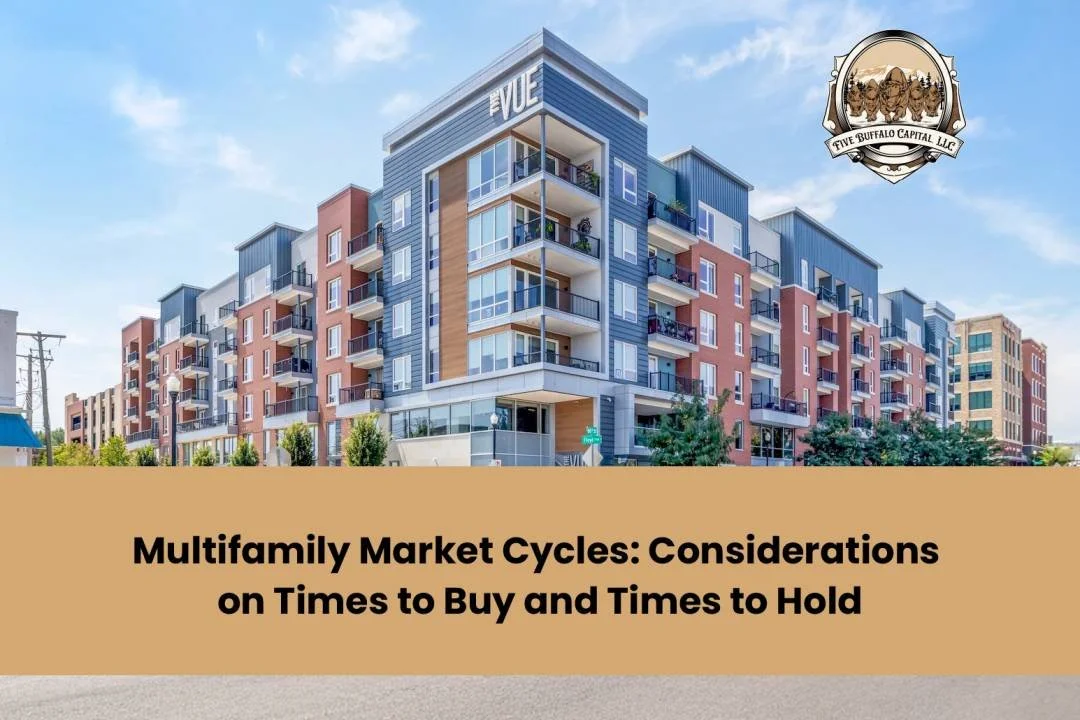
Understanding indicators of when to buy and when to hold multifamily properties can make the difference in successful real estate investing. The market doesn't move in a straight line—it follows historically predictable patterns that savvy investors often learn to recognize and leverage. Whether you're exploring commercial real estate investing or considering passive real estate investing opportunities, knowing these cycles is crucial in understanding the components of an investment’s potential.
Understanding the Four Phases of Real Estate Market Cycles
Real estate markets move through four distinct phases, each presenting unique characteristics and opportunities for multifamily investors. Recognizing where we are in the cycle can help an investor decide whether it's time to acquire new properties, hold current investments, or sell investments.
Phase 1: Recovery – The Bottom-Fishing Opportunity
The recovery phase emerges after a market downturn when prices have stabilized and early signs of growth appear. During this period, occupancy rates begin climbing from their lows, though rental growth remains modest. Historically, this is when investors will start to buy..
Key indicators of the recovery phase include declining vacancy rates, stabilizing property values, and renewed interest from institutional buyers. Construction activity generally remains low since developers tend to be cautious from the previous recession. This creates supply constraints that can benefit properties purchased during this window.
For those interested in multifamily acquisitions, recovery represents a historically favorable entry point. Properties in this phase can be acquired below replacement cost, and financing terms may be more favorable due to recovering economic drivers. . The risk may be elevated as investors are making an assumption that the market will continue an upward trajectory after a period of recession.
Phase 2: Expansion – Riding the Wave
Expansion is where markets really heat up. Occupancy rates will often be seen pushing toward 95% or higher, rents will see more consistent increases, and property values often appreciate noticeably. In the expansion phase, it is common to see investor confidence surge and subsequently more capital flow into deals. During expansion, holding existing properties typically generates returns through both cash flow and appreciation. Rent growth can outpace inflation, and strong demand often supports regular rent increases. Investors who purchased during the recovery phase will often see their foresight paying off as property values appreciate. Depending on the interest rates and leverage on an asset, experienced operators of existing products may use this time to renovate properties to attract new and retain current residents.
While expansion tends to create favorable conditions for owners, buying during this phase requires caution. Properties often command premium prices, and competition for deals usually intensifies. Success during the expansion phase greatly depends on identifying markets or submarkets that still have room to run rather than chasing markets that may be approaching peak pricing. Proper due diligence and conservative assumptions are helpful in underwriting deals during the expansion phase.
Phase 3: Hyper-Supply – Proceed with Caution
The hyper-supply phase occurs when construction activity reaches excessive levels relative to demand. Developers, encouraged by the expansion phase's success, deliver a wave of new inventory. These deliveries often happen within a few months of each other causing local market absorption issues. Vacancy rates will tend to tick upward, rent growth slows or stalls, and property owners face increasing competition for residents.
This phase presents challenges for multifamily operators. Concessions become common as properties compete for residents. New developments with modern amenities draw residents away from older properties unless those properties have been well-maintained and upgraded. Real estate investment fund managers must be particularly selective during this period.
For buyers, hyper-supply can offer selective opportunities—particularly for well-located properties being sold by owners who overextended themselves. However, the window between "good deal" and "falling knife" narrows considerably. Due diligence becomes even more critical, with extra attention paid to supply pipelines, employment trends, conservative budget assumptions, and submarket dynamics.
Phase 4: Recession – The Reality Check
The recession phase tends to bring declining occupancy, falling rents, and reduced property values. Economic uncertainty causes less household formation and residents look for less expensive alternatives. Owners with overleveraged properties may face distress, and transaction volume typically drops as buyers and sellers struggle to agree on pricing.
While recession sounds ominous, it serves an important function by clearing excess inventory and resetting expectations. For investors with capital and patience, the recession phase can set the stage for the next recovery phase. Properties acquired during recession—particularly from distressed sellers—can often become the high performers of the subsequent cycle.
The key during recession is survival: maintaining adequate reserves, avoiding excessive leverage, and keeping properties occupied even if that means flat or negative rent growth. Investors who can weather the storm position themselves in a better place for the recovery that inevitably follows.
Key Indicators That May Signal Buying Opportunities
Beyond understanding cycle phases, multifamily investors should monitor specific indicators that may signal favorable buying conditions:
Employment Growth and Job Diversification
Markets with expanding employment and diverse industries tend to support multifamily demand through various economic conditions. Texas cities have benefited from this dynamic, with sectors ranging from technology and healthcare to energy and logistics supporting rental housing demand.
Population Migration Patterns
In-migration creates housing demand. Markets attracting residents from other states or metro areas—often driven by job opportunities, affordability, or lifestyle factors—typically see sustained multifamily performance. Tracking U-Haul patterns, census data, and corporate relocations can provide insight into migration trends.
Supply-Demand Balance
Construction permits, development pipelines, and absorption rates often reveal whether supply and demand are in balance. Markets where absorption consistently exceeds new deliveries reflects favorable conditions for rent growth and occupancy. Conversely, markets with excessive construction relative to demand are often facing headwinds.
Cap Rate Spreads
The difference between capitalization rates and borrowing costs can impact returns. When cap rates significantly exceed financing costs, investors have the potential to achieve positive leverage—where borrowed money enhances returns. Compressed spreads reduce this advantage and may signal overheated pricing.
Hold and Exit Strategies: Seeking to Maximize Value During Ownership
Knowing when to hold is equally important as knowing when to buy. Effective hold strategies depend on both market conditions and property-specific factors.
Value-Add Repositioning
During the early and middle stages of ownership—particularly properties acquired during recovery or early expansion phases—implementing value-add strategies has the potential to accelerate returns. Thoughtfully renovating units, upgrading amenities, and improving operations often allows owners to capture higher rents and increase property values.
Market Maturity Assessment
As markets mature through expansion and approach hyper-supply, hold-versus-exit decisions become more nuanced. Properties that have experienced significant appreciation may represent profit-taking opportunities, particularly if reinvestment options in earlier-stage markets exist. However, properties generating strong cash flow with manageable debt may warrant continued ownership even as markets peak.
Debt Maturity Considerations
Financing structures influence hold decisions. Properties with favorable long-term, fixed-rate debt may be considered worth holding even during softer market conditions. Conversely, properties approaching refinancing with floating-rate debt during periods of high interest rates may necessitate sale or recapitalization. The capital stack of an investment is an important consideration in the exit strategy as it can impact the ability of the investment to be held or exited.
Tax Planning and 1031 Exchanges
Tax implications may affect hold and exit decisions significantly. Investors facing substantial capital gains may prefer to extend hold periods to defer taxes or explore 1031 exchange opportunities to redeploy capital while preserving tax efficiency. Working with professional tax advisors can help optimize these considerations within an overall portfolio strategy.
Important Information: Blogs are intended to be educational and rely on information from sources deemed to be reliable. Nothing in this blog contains legal, tax, financial, or any other type of advice. All investors should consult their own financial, tax, legal, and other professional advisors to determine if an investment is suitable for their unique situation.
All investments have risk. Please view our disclosures.